
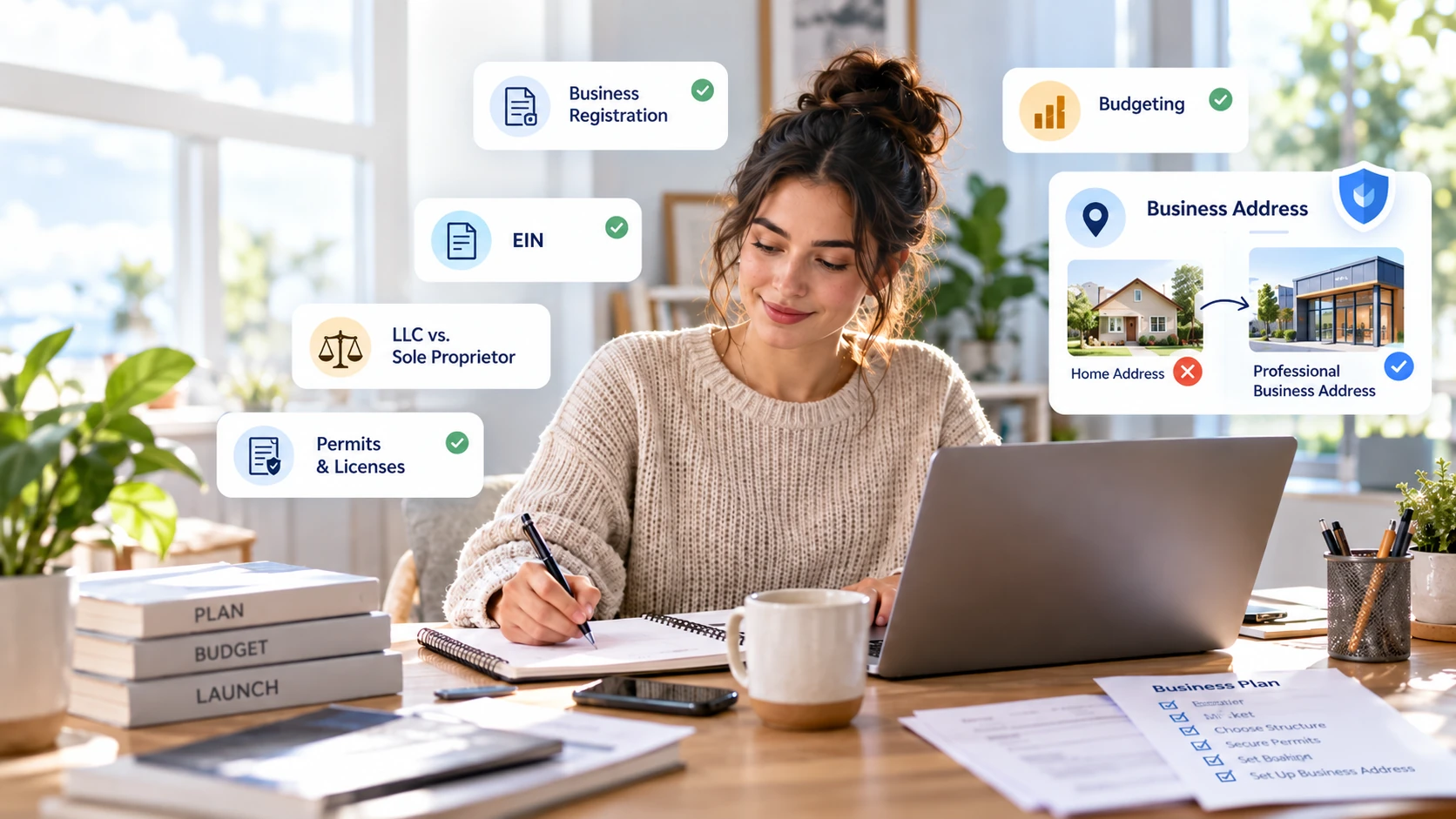
Every founder hits the same wall. You have the idea and a laptop, but nobody explains the order: what to register, what to pay for, and whose address goes on the paperwork. Most guides on how to start a small business stop at "write a business plan." You're in good company, though: the U.S. Census Bureau reported 534,947 business applications in September 2026 alone (seasonally adjusted).
This guide shows how to start a small business from home with real steps, a real case study, and the address decision most first-timers get wrong. If you've been asking how to start a small business with no office, start here.
How do I start a small business from home?
Starting a business from home is a short sequence, not one big leap. Three things usually go wrong.
- Skipping validation: Founders pay for logos and websites before one customer has paid them.
- Guessing at paperwork: Rules differ by state and city.
- Using the home address by default: It lands on public records, invoices, and your website.
What are the steps to start a small business at home?
Here is how to start a small business at home, with the questions founders keep asking on forums like Reddit and Quora answered at each step:
1. What should I do first?
Test the idea. Pre-sell to five to ten real customers or run a small test batch. A paid order proves more than a survey.
2. Do I need an LLC, or can I stay a sole proprietor?
You can start as a sole proprietor. Per Chase, that needs no formal state filing, and income goes on your personal return. An LLC adds liability protection, but it brings state filing fees, and most states also charge annual reports. If you switch later, you may need a new EIN.
3. Do I need an EIN?
It is free. The IRS says you never pay a fee and warns about sites that charge. Sole proprietors can often use an SSN, but an LLC generally needs an EIN, and so does most business banking. Apply online in one sitting, since the form expires after 15 minutes of inactivity, and form an LLC with your state first.
4. Can I deduct my home office?
Only if part of your home is used regularly and exclusively for business, and it is your principal place of business, per the IRS. A laptop on the sofa does not count. Ask a tax professional.
5. Do I need business insurance?
The Hartford says home-based businesses typically need general liability, and often professional liability or a business owner’s policy. Check your lease or HOA first.
6. Which address do I use?
Decide before it spreads across your registration, bank account, and website.
That's how to start a small business without overcomplicating it: one question at a time.
Case study: how Spanx began with $5,000
Sara Blakely launched Spanx in 2000 with $5,000 of her own savings and took no outside investment, according to Stanford Graduate School of Business. So how do you start a small business with a few thousand dollars? Her moves mirror the steps above: manufacturers said no for two years, she wrote her own patent to save on legal fees, and she packed, shipped, and sold in the early days. It was profitable from the start.
What is the cheapest way to start a small business from home?
Anyone asking how to start small business ventures on a budget gets the same answer: starting a business does not need much cash up front, so budget by line item. There is no single number, but here is the ladder.
|
Cost |
What to expect |
Note |
|
EIN |
$0 |
The IRS charges no fee |
|
Sole proprietorship |
No state formation filing |
Local licenses may still apply |
|
LLC |
State fee, varies |
Most states add annual reports |
|
Business license |
Varies by city |
Check with your city or county |
|
Business address |
$0 a month, or from $15 |
BoxFo pay-as-you-go or plans |
What costs catch home-based founders off guard?
Annual LLC reports, permit renewals (The Hartford notes some need frequent renewal), sales tax registration, and insurance. If you need funding, SBA microloans go up to $50,000, averaging about $13,000, per The Hartford.
Pay-as-you-go helps here. Starting a small business should not mean a monthly fee before your first sale.
What licenses and permits do I need to start a business from home?
However you approach how to start a small business from home, the rules depend on where you live and what you sell, so treat this as a checklist, not legal advice. Starting a small business at home rarely takes one permit. Check:
-
A general business license: from your city or county
-
Home occupation and zoning rules: customer visits, signage, and deliveries
-
A sales tax permit: if you sell taxable goods or services
-
Your lease or HOA terms: some require written approval
Start with the SBA’s launch guidance, then read is a virtual address legal in the USA.
Can I use my home address for my small business?
Yes, plenty of people do when starting a small business. Most advice on how to start a small business skips the catch: many filings are public, so your address can become searchable.
|
Where it appears |
Home address |
Virtual business address |
|
Business registration |
Part of a public record |
A street address that is not your home |
|
Website and invoices |
Shows where you live |
Shows a professional address |
|
If you move |
Update every filing |
Keep the same address |
Our post on why every home-based business needs a professional business address goes deeper.
Do I need a business address for an online business?
In practice, yes. Wondering how to start small business operations fully online? Your registration, bank account, payment processor, and tax forms each ask for one. Sellers can read our guide to a virtual business address for Amazon, Etsy and Shopify sellers.
Is a virtual business address a good option for a home-based business?
For anyone working out how to start a small business at home, usually yes. It also helps with how to start small business paperwork without exposing your home.
Home address vs virtual business address
Home address: Free, but it ties your business to where you live.
Virtual business address: It separates home from business, and your mail is handled online.
Virtual business address vs renting an office
Renting an office: You get workspace, but you pay monthly whether you use it or not.
Virtual business address: You get the address without the lease.
Whichever provider you choose, confirm it follows USPS rules, including Form 1583, which our guide to mail forwarding rules and USPS Form 1583 explains.
This is where BoxFo fits in
BoxFo gives home-based founders a US business address and a virtual mailbox in one place. See the virtual business address page, or the small business owners page.
-
A real street address for your registration, website, and bank account
-
Mail scans so you can read what arrives from anywhere
-
Free shredding and check deposit, which costs shipping plus $5
-
Pay-as-you-go with no monthly fee, or plans from $15 a month, on the pricing and plans page
1. Create your account: Sign up and choose pay-as-you-go or a monthly plan.
2. Verify your identity: Complete the USPS Form 1583 verification online.
3. Use your address: Add it to your registration, bank account, website, and invoices.
Your home stays private, and starting a small business feels simpler when your paperwork has somewhere to land.
So how to start a small business from home comes down to this: test the idea, register properly, check your permits, and pick an address you won't regret. Still asking how to start a small business at all? Begin with step one, because starting a business is a sequence, not a leap. Once you know how to start a small business, the address is the one decision worth making early.